Croissants

Make flaky, buttery Croissants at home with this hands-on recipe for crisp layers and golden crescents.
Ingredients
- 1 cup milk
- 1 packet instant yeast (2 1/4 teaspoon)
- 1 tablespoon granulated sugar
- 1 teaspoon salt
- 2 tablespoons unsalted butter (room temperature)
- 3 cups all-purpose flour
- 1/2 cup unsalted butter (chilled and sliced into squares)
- 1 whole egg
- 2 tablespoons milk
Instructions
Step 1: Prepare the milk and activate the yeast
Warm the milk to about 110–115°F, then combine it with the instant yeast and the tablespoon of granulated sugar in a small glass jug or bowl and stir gently until the yeast has dissolved and the mixture looks slightly frothy. In the bowl of a stand mixer fitted with the dough hook, add the flour, salt, and the 2 tablespoons of room-temperature unsalted butter, then pour in the warmed milk-yeast mixture and mix on low until the dough just comes together. Continue mixing on low speed for 5–6 minutes until the dough is smooth and slightly elastic. Shape into a tight ball, transfer to a lightly oiled bowl, cover, and let rise undisturbed until doubled in size, about 1–1½ hours.
Step 2: Build the butter block
On a large piece of parchment with a measured 8×6" square faintly marked on the reverse, arrange the ½ cup of chilled, sliced butter into the square so the pieces fill most of the area. Fold the parchment tightly over the butter, then use a heavy rolling pin to compress and roll the butter into an even, cohesive block roughly within that rectangle, taking care not to tear the paper. Return the sealed butter block to the refrigerator to chill for 30 minutes so it firms up again while the dough finishes its first rise.
Step 3: Enclose the butter and chill the dough
Once the dough has doubled, gently deflate it and roll it into a 6×14" rectangle. Place the chilled butter block centered on the dough and fold each long side over so the two edges meet and the butter is fully enclosed; press and pinch the seam to seal. Cover the folded dough and refrigerate for 30 minutes to relax and firm the butter-dough package before beginning the turns.
Step 4: First and second turns (lamination begins)
With the seam running lengthwise, roll the dough in that same direction to a roughly 18×8" rectangle, keeping corners as square as possible. Perform a letter fold (fold the bottom third up, then the top third down) to complete one turn; rotate so the open edges face you, roll to the same rectangle size again and repeat the letter fold for a second turn. After these two turns, cover and refrigerate for 1 hour to keep the butter cold and the layers distinct.
Step 5: Final two turns and resting
Remove from the fridge and repeat the rolling and letter-fold sequence two more times, taking care to keep the dough cold and the edges sharp; after these final turns, chill the dough for 2 hours to relax the gluten and consolidate the laminations before shaping.
Step 6: Roll, trim, and cut into triangles
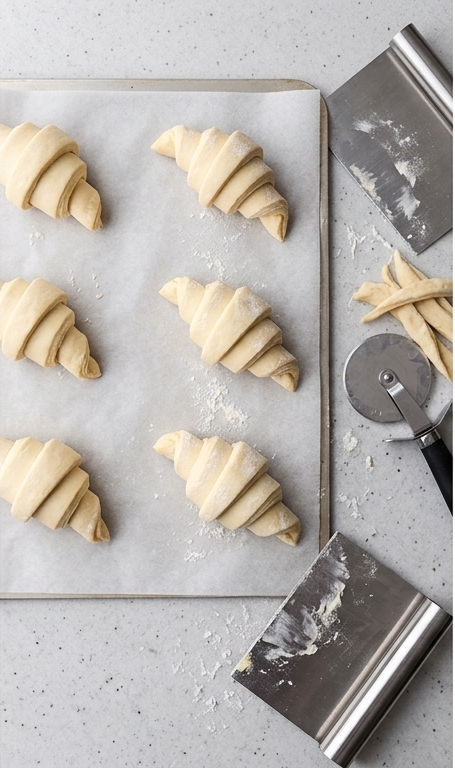
With the exposed folded edges facing you, roll the fully laminated dough into a long rectangle about 24×8", using quick, confident strokes and stretching the corners by hand to maintain square edges. If you want crisp, sharp edges, trim a scant ¼" from both long sides with a very sharp pizza cutter or bench scraper. Cut the rectangle into six 8×4" sections, then cut each rectangle diagonally into two triangles. Make a ½" slit at the base of each triangle and roll each from base to point, tucking the point under to form classic crescent shapes; place the shaped croissants on a parchment-lined baking sheet with spacing for expansion.
Step 7: Proof the shaped croissants
Cover the baking sheet lightly with plastic wrap or a clean kitchen towel and let the croissants proof at room temperature until noticeably puffy and jiggly, about 2–2½ hours. They should increase in size and show delicate wrinkles where the layers are separating a little.
Step 8: Egg wash and bake
Whisk the whole egg together with 2 tablespoons of milk to make a glossy egg wash, then gently brush one thin coat over each croissant and let it dry for 5 minutes before applying a second coat. Transfer the sheet (one at a time) to the oven to bake until deeply golden—first at a higher temperature to encourage lift, then lowered to finish through—until the exterior is a deep, even golden brown and the layers are crisp and audible when you tap them. Allow the croissants to cool for about 20 minutes to set and to let the interior finish steaming.
Step 9: Plate and serve
Nestle the warm, flaky croissants into a shallow, rustic bowl lined with a soft gray-and-white striped cloth so the golden, multi-layered curves are visible and inviting. Let them rest briefly so the butter smell fills the air, then serve warm, allowing the flaky crescents and delicate interior layers to be enjoyed immediately.

Notes
- Keep all ingredients and the dough cold to preserve distinct layers
- Use a sharp cutter and a light touch when trimming to avoid compressing laminations
- Freeze shaped but unbaked croissants for up to one month and bake from thawed after proofing