Rhubarb Pie has a way of bringing spring to the table, and this recipe is one I come back to every year. I remember the first time I made Rhubarb Pie for a neighborhood potluck — the smell of caramelizing sugar and tart rhubarb filled my kitchen and people kept asking for seconds. I love how simple ingredients transform into something both rustic and elegant, and this version balances bright rhubarb with a flaky double crust. It’s approachable, forgiving, and perfect with a scoop of vanilla ice cream on top.
There’s something special about the contrast of textures and flavors in a classic Rhubarb Pie. The filling is pleasantly tart without being harsh, and the crust offers that buttery, flaky frame that makes each bite complete. If you’ve never tried rhubarb in a pie before, this is the one to start with — it’s straightforward, satisfying, and reliably delicious.
When This Pie Became My Spring Ritual
One soggy afternoon in early May, I found myself with a bag of rhubarb stalks and a stubborn craving for something bright and homey. I’d never baked a full pie before that month, but the rhythm of chopping the ruby stalks, stirring sugar until it glistened, and rolling out the crust settled something inside me. The first taste was shockingly good: tart, sweet, and a little grassy in the best way. I still remember the sound of the crust as I cut the first slice, the steam rising and carrying that unmistakable rhubarb perfume across the kitchen. Friends who tried it said it tasted like sunshine after rain, and it became my go-to for early-season gatherings. Over the years I’ve tweaked the sugar and flour ratios, learned to trust a good rest time so slices hold their shape, and now the Rhubarb Pie feels like a seasonal handshake between me and the garden.
The Ingredients That Make It Sing
- Double Pie Crust: The foundation — flaky, buttery, and responsible for that tender bite. Substitute with a single crust plus a crumble topping if you want less pastry. Choose a cold crust or make your own with cold butter for best flakiness.
- Granulated Sugar: Balances the tartness of rhubarb. You can reduce by a few tablespoons or swap part for brown sugar for a deeper, caramel note.
- All-Purpose Flour: Acts as the thickener so the filling sets. Tapioca or cornstarch are fine substitutes if you prefer a clearer filling; reduce amounts slightly.
- Rhubarb: The star tart vegetable — look for firm, bright stalks without limp ends. Frozen rhubarb works in a pinch but may release more liquid.
- Cinnamon: A warm whisper that complements rhubarb’s tang. Omit or replace with a pinch of nutmeg for a different nuance.
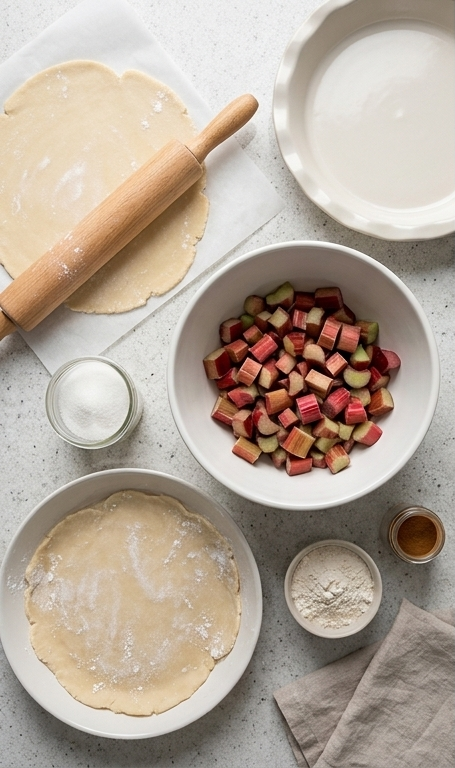
Essential Kitchen Tools and Why They Matter
A few simple tools make this Rhubarb Pie much easier and help produce consistent results. A solid rolling pin helps you get the crust thin and even so it bakes uniformly. A 9-inch pie plate is ideal for the amount of filling here; metal heats a bit faster while ceramic holds heat for longer. A sharp knife and a sturdy cutting board make quick work of the rhubarb stalks and keep pieces uniform so they cook evenly. Use a mixing bowl large enough to toss the filling without spills, and a pastry brush if you like to egg-wash the crust for sheen.
- Rolling pin: For even crust thickness; use a dowel or wine bottle as an alternative.
- 9-inch pie plate: Standard size; swap for 8 or 10 inches but adjust filling and baking time slightly.
- Sharp knife and cutting board: For clean rhubarb cuts; kitchen shears can work for small jobs.
- Mixing bowl: Big enough to toss ingredients; a large bowl prevents mess.
- Pastry brush: Optional, for brushing away excess flour or applying wash; use your fingers if needed.
Step-by-Step Preparation Guide
Step 1: Preheat the oven
Preheat the oven to 425°F so it’s ready when the pie is assembled. This initial blast of heat helps set the crust quickly and encourages a flaky rise—so get that oven warm while you work, and have your 9-inch pie plate and rolling surface prepared nearby.
Step 2: Roll and line the pie plate
Roll one half of the double pie crust to about 1/8-inch thickness on a lightly floured surface and gently ease it into a 9-inch pie plate so it sits snugly with a slight overhang. Scatter a small mixture of 1 tablespoon granulated sugar and 1 tablespoon all-purpose flour across the bottom of the lined crust; this thin layer helps absorb extra juices and keeps the bottom crust from getting soggy.
Step 3: Combine the filling
In a large mixing bowl toss 6 cups of rhubarb (trimmed and cut into ½-inch pieces) with 1 cup granulated sugar, 6 tablespoons all-purpose flour (reserve a little for dusting if needed), and ½ teaspoon cinnamon. Mix until the pieces are evenly coated and the sugar begins to draw out the rhubarb’s juices—what you want is a glossy, slightly saucy pile of ruby-red chunks with a light dusting of flour binding the sweetness to the fruit.
Step 4: Fill the crust and assemble the top
Spoon the rhubarb mixture into the prepared bottom crust so the filling mounds slightly but is level with the rim. Roll the remaining crust to the same thickness, then place it over the filling — either cut into strips for a woven lattice or leave whole and cut slits for ventilation. Crimp the edges to seal, tidy the rim, and brush away any excess flour. The assembled, unbaked pie should look taut with visible ruby filling peeking through any lattice or slits.
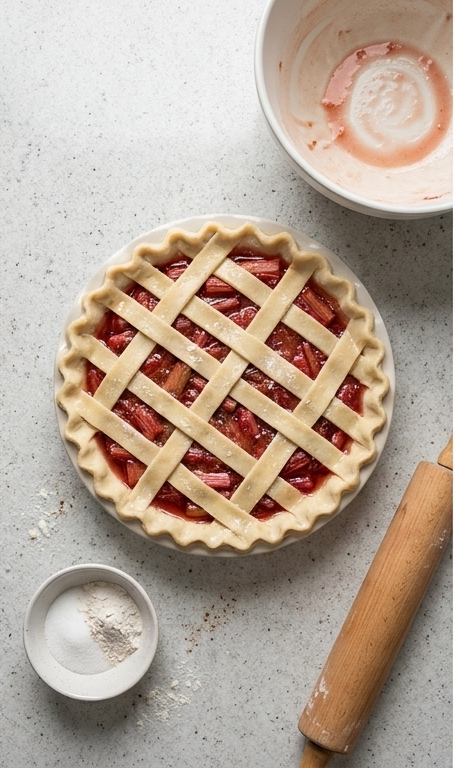
Step 5: Start baking and finish at temperature
Bake the assembled pie on the bottom rack of the oven for 15 minutes at 425°F to jump-start browning, then reduce the oven temperature to 350°F and continue baking for 40–50 minutes more until the filling is bubbling through the vents and the crust is a deep golden brown. The visual cues are important: deep golden edges and glossy bubbling filling mean the sugars and rhubarb have concentrated and thickened properly.
Step 6: Cool and serve
Remove the pie and let it cool on a wire rack for about 2 hours; cooling lets the filling set so slices hold their shape. When ready to serve, cut a generous wedge and plate it. A warm slice benefits from a scoop of creamy vanilla ice cream that softens against the hot filling, with a few small pieces of fresh rhubarb scattered as garnish for a bright, fresh note.
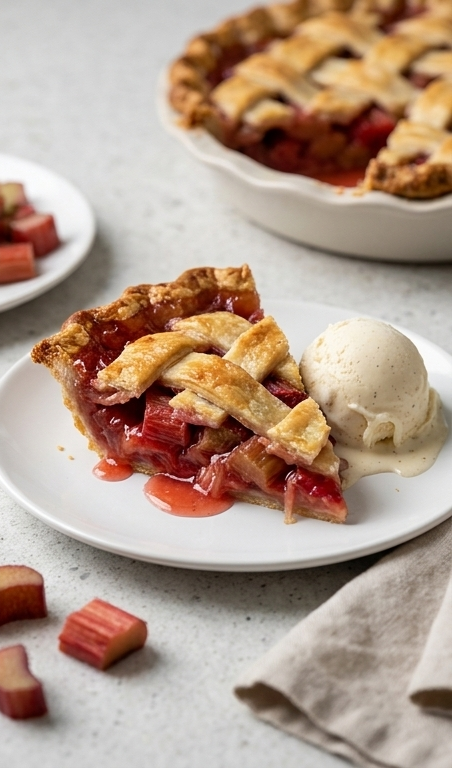
Making It Your Own
I like to experiment with small swaps depending on the season. Some springs I stir in a handful of diced strawberries for a sweeter, redder filling; other times I fold in a tablespoon of lemon zest for extra brightness. For a gluten-free version, I replace the flour in the filling with a blend of cornstarch and a touch of instant tapioca and use a store-bought gluten-free crust. If you prefer less sugar, reduce the granulated sugar by 2 to 4 tablespoons and taste as you go — rhubarb varies in tartness. Each tiny change becomes a new favorite after one or two trials.
How to Serve
When hosting, I slice the pie into generous wedges and plate them on dinnerware that shows off the pie’s ruby filling. A classic pairing is vanilla ice cream; for a grown-up touch try a dollop of lightly sweetened mascarpone or whipped cream with a splash of vanilla. To stretch servings for a larger crowd, cut smaller slices and serve alongside a simple cheese course or fruit salad. For a casual gathering, serve warm on a platter and offer spoons of cream and a bowl of thinly sliced fresh rhubarb for garnish.
Storage and Reheating Tips
Store leftover Rhubarb Pie covered loosely with foil or plastic wrap at room temperature for up to one day. For longer storage, refrigerate tightly wrapped for up to 4 days. If you want to freeze, wrap cooled slices individually in plastic and place them in an airtight container for up to 3 months.
To reheat, warm a slice in a 350°F oven for 10 to 15 minutes until just heated through to preserve the crust’s texture. Avoid the microwave when possible because it can make the crust soggy; if you must use the microwave, zap briefly and then crisp in a toaster oven or under the broiler for a moment.
Common Slip-Ups and How to Avoid Them
A frequent mistake is using rhubarb pieces that vary wildly in size, which leads to uneven cooking. Chop uniformly and toss to coat so everything finishes at the same time. Another misstep is skipping the initial high heat; that first burst helps set the crust and prevents a limp bottom.
Overfilling or failing to vent the top can cause boilovers and a wet crust; leave a little room and make vents or a lattice so steam escapes. Lastly, slicing too soon risks a runny slice — patience during the cool-down rewards you with clean wedges.
Final Thoughts
Give this Rhubarb Pie a try the next time rhubarb appears at the market. It’s forgiving, bright, and a lovely way to celebrate seasonal produce. I think you’ll love how the tart filling and flaky crust come together — and the chance to share it with friends makes it even better.
Frequently Asked Questions
- What if my rhubarb is really tart? Try adding 1 to 2 extra tablespoons of sugar or stir in a few diced strawberries to mellow the tartness.
- Can I use frozen rhubarb? Yes, but thaw and drain excess liquid before mixing with sugar to avoid a watery filling.
- How do I keep the bottom crust from getting soggy? Sprinkle the crust with a mix of 1 tablespoon sugar and 1 tablespoon flour before adding the filling; blind-baking lightly can also help.
- Is there a good substitute for the all-purpose flour in the filling? Cornstarch or instant tapioca work well; reduce amounts slightly and test consistency.
- Can I make this ahead? You can assemble and refrigerate the unbaked pie for a few hours or freeze it wrapped for longer storage.
Rhubarb Pie
Make a classic Rhubarb Pie with a flaky double crust and tangy-sweet filling — easy steps for a seasonal favorite.
Ingredients
Instructions
Step 1: Preheat the oven
Preheat the oven to 425°F so it's ready when the pie is assembled. This initial blast of heat helps set the crust quickly and encourages a flaky rise—so get that oven warm while you work, and have your 9-inch pie plate and rolling surface prepared nearby.
Step 2: Roll and line the pie plate
Roll one half of the double pie crust to about 1/8-inch thickness on a lightly floured surface and gently ease it into a 9-inch pie plate so it sits snugly with a slight overhang. Scatter a small mixture of 1 tablespoon granulated sugar and 1 tablespoon all-purpose flour across the bottom of the lined crust; this thin layer helps absorb extra juices and keeps the bottom crust from getting soggy.
Step 3: Combine the filling
In a large mixing bowl toss 6 cups of rhubarb (trimmed and cut into ½-inch pieces) with 1 cup granulated sugar, 6 tablespoons all-purpose flour (reserve a little for dusting if needed), and ½ teaspoon cinnamon. Mix until the pieces are evenly coated and the sugar begins to draw out the rhubarb’s juices—what you want is a glossy, slightly saucy pile of ruby-red chunks with a light dusting of flour binding the sweetness to the fruit.
Step 4: Fill the crust and assemble the top
Spoon the rhubarb mixture into the prepared bottom crust so the filling mounds slightly but is level with the rim. Roll the remaining crust to the same thickness, then place it over the filling — either cut into strips for a woven lattice or leave whole and cut slits for ventilation. Crimp the edges to seal, tidy the rim, and brush away any excess flour. The assembled, unbaked pie should look taut with visible ruby filling peeking through any lattice or slits.
Step 5: Start baking and finish at temperature
Bake the assembled pie on the bottom rack of the oven for 15 minutes at 425°F to jump-start browning, then reduce the oven temperature to 350°F and continue baking for 40–50 minutes more until the filling is bubbling through the vents and the crust is a deep golden brown. The visual cues are important: deep golden edges and glossy bubbling filling mean the sugars and rhubarb have concentrated and thickened properly.
Step 6: Cool and serve
Remove the pie and let it cool on a wire rack for about 2 hours; cooling lets the filling set so slices hold their shape. When ready to serve, cut a generous wedge and plate it. A warm slice benefits from a scoop of creamy vanilla ice cream that softens against the hot filling, with a few small pieces of fresh rhubarb scattered as garnish for a bright, fresh note.
Notes
- Chill your crust ingredients so the pastry stays flaky.
- Trim and cut rhubarb into uniform ½-inch pieces for even cooking.
- Allow the pie to cool for about 2 hours to let the filling set before slicing.
- If the filling seems too loose, let the pie bake until the filling is visibly bubbling.
- Freeze leftover slices individually for easy thaw-and-reheat portions.